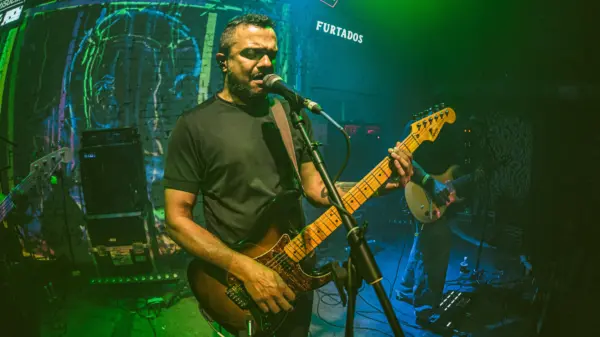
















Somewhere in India, a dimly lit bar lights up with the sound of fuzzy guitar licks, almost as if someone is trying to conjure the presence of Jimi Hendrix, followed by a Stevie Ray Vaughan classic. Two friends, perhaps in their late 20s or 30s, can’t help but strike a conversation about how rock is still the real deal.
What follows is a familiar complaint, “India just doesn’t have a culture of rock. I don’t know why it’s Bollywood everywhere.”
Does it sound familiar? This conversation. I am sure many of us have had these discussions prior, sometimes while sipping peg after peg or while smoking pot, far away from a world plagued by algorithms and polarisation.
This isn’t a new problem. It has existed for decades. But is it truly just a cultural failure? I find it worth an argument. The absence of a rock-listening culture that we so often talk about is, in my opinion, highly structural.
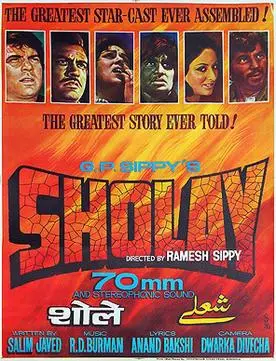
Theatrical release poster of Sholay (Source: Wikipedia)
Whenever someone laments that “Indians only listen to Bollywood,” it is worth pausing to look at who is speaking and from where. That critique almost always originates from an urban, English-educated, middle-to-upper-class vantage point.
To look down on mass consumption of Bollywood music while championing western genres without addressing the reason properly is problematic. It assumes that musical taste exists in a vacuum of pure merit, ignoring the reality that what people listen to is dictated entirely by what they are given access to. Before we blame the Indian listener for “settling” for Bollywood numbers, the conversation needs to shift from cultural inclination to access and infrastructure.
Bollywood’s omnipresence in India isn’t an accident of public taste but a product of decades-old industrial infrastructure. It costs nothing to encounter Bollywood. You do not need to seek it out, it permeates the air of public and private life easily. Someone playing a Sadhana Sargam number in a nearby Paan shop, a bus driver listening to Kumar Sanu, a group of teenagers listening to Badshah, it’s a familiar sight in India.
Historically, this landscape was forged through heavy-handed state gatekeeping and subsequent market disruption. In 1952, B.V. Keskar, the Minister of Information and Broadcasting, banned the airing of Hindi film (the term Bollywood was coined in the 1970s) songs on Akashvani (All India Radio) alongside Western music. This severe restriction backfired, driving Indian listeners to tune into Sri Lanka’s Radio Ceylon, which broadcasted Binaca Geetmala. Faced with a listener exodus, the Government relented and Vividh Bharati was launched in 1957 to feed on the appetite of the listener, which led to Hindi film music being cemented as the default national soundscape.
In the 1980s, market dynamics shifted through the cassette revolution pioneered by Gulshan Kumar’s T-Series. Although T-Series initially expanded by capitalising on pirated Hindi film tracks, it gradually built large-scale, legitimate production facilities. By mass-producing affordable audio cassettes and flooding every corner of the country, from highway dhabas to a family residing in an apartment, the music label transformed film soundtracks into an easily accessible commodity.
So it’s not like Bollywood won a fair cultural war against rock, but what it did is build the roads to enter more spaces first. Rock music, meanwhile, often relied on different entry points including an English-medium school where a band performs, a college festival, a friend who introduces someone to the genre, or a venue hosting live music. India already had a record industry in the 1950s and 1960s, with the Gramophone Company of India selling vinyl records by rock and roll artists from the US and Britain, as well as some early Indian rock bands. However, the availability of these records did not mean everyone could afford them. Imported records could be difficult to find, and record players were expensive for many households. Many listeners also depended on friends, overseas contacts or someone willing to share their music collections. Although these were not the only ways people discovered rock, they reflect a broader pattern in how the genre reached Indian audiences over the decades, and that raises an important question: Who actually gets the opportunity to discover rock in the first place?

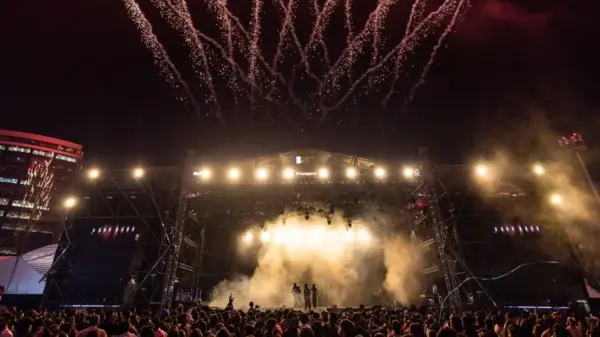
Kodaline performing at NH7 Weekender, Pune
Fast-forward to today and streaming has made music more accessible than ever. You no longer need to attend a concert or study at an English-medium school to listen to rock. But access to the music itself doesn’t automatically translate into discovering the genre, understanding its influences or connecting with its culture. Those experiences are often shaped by the people, spaces and opportunities one encounters, and access to them remains far from equal.
There is another barrier worth considering, and that is, the resistance that western musical genres can encounter in the name of preserving Indian culture even today. For some, rock music represents an unwanted foreign influence and this attitude can make efforts to introduce western genres to new audiences a struggle, particularly when organisers attempt to bring such music into communities or spaces where it is viewed with suspicion or lack of enthusiasm.
Education is another part of that equation. India’s policies do recognise the importance of arts education, but its implementation remains uneven. A 2026 NITI Aayog report identifies limited access to specialist teachers, inadequate facilities, and a tendency for arts education in many government schools to be confined to occasional annual functions. Where students have limited opportunities for structured music education and proper instruments, genres such as rock can become dependent on resources outside school. This includes investment not only on instruments, but gears, jamming spaces, and performance venues, which may not be possible for everyone to afford.
The point, then, is not that rock music is actually inaccessible to everyone outside privileged circles. It is that the freedom to discover a genre, learn to play it, and participate in its culture is not distributed equally. Bollywood benefits from an established mass-cultural ecosystem, along with the advantage of Hindi being understood by most of Indians. Rock has had to build its audience through a more fragmented network of musicians, venues, institutions, and communities.
However, India’s musical landscape is not without exceptions. Examples can be drawn from parts of the Northeast and along the western coast, where western musical traditions found roots in community institutions rather than remaining confined to elite cultural spaces.
In Meghalaya, churches and missionary schools helped introduce western music, including hymns, choral singing, and musical notation. These practices allowed musical knowledge to spread through churches, schools, and community gatherings, creating a foundation for western genres to take root. By the 1960s and 1970s, Meghalaya’s musical landscape was evolving further, with rock and roll finding its way into Shillong through shortwave radio broadcasts and smuggled vinyl records, as documented by Meghalaya Cabs.
This wider musical culture became part of the foundation for a thriving rock scene. As Momo, the bassist of the Meghalaya-based band Bending Waves recalls, “Rock has always been playing in the background in Shillong. I have been subconsciously listening to rock ever since I was little.” He adds, “Names like Bryan Adams, Guns n Roses and Scorpions were and have been a house-hold name since times unknown.” This pipeline continues to find expression in diverse forms, from the acclaimed Shillong Chamber Choir to celebrated blues rock acts like Soulmate.
In Goa, Portuguese colonial rule and Catholic missionaries introduced western music through church services and parish schools, where generations learned choral singing, notation, and instruments. Over time, community performances helped take these traditions beyond the church, creating a strong foundation for western music to become part of everyday Goan cultural life.
These examples show what becomes possible when musical traditions are embedded in community life rather than confined to elite cultural spaces. So, instead of dismissing the dominance of Bollywood as a matter of public taste (where a large share of the workforce earns relatively modest incomes) we need to ask a more meaningful question, “What would it take for every individual, including a working-class person in Nagpur or Patna to encounter rock music as a genuine possibility?”
First, music education in public schools needs to go beyond occasional performances and make room for structured training, access to instruments and opportunities to learn different musical traditions. Second, community radio, local music networks, and independent digital platforms must help regional rock acts reach audiences beyond metropolitan circles. This is part of what we, at The Indian Music Diaries, are striving to do by documenting India’s independent music scene and bringing more artists and stories into the conversation. Finally, cities need to put funds into decentralised live-music infrastructure, from affordable rehearsal spaces to subsidised community venues, and all-ages gigs, where emerging bands can perform without depending on expensive pubs and nightclubs.
With a digression here, I’d like to come back to my core argument that ultimately, the person who “only listens to Bollywood” may simply have been given Bollywood at every turn. They grew up with a cultural apparatus backed by decades of film production, radio, television, distribution networks, and music woven into everyday life. Their exposure was not accidental, but it was built. Other genres have rarely enjoyed the same reach, and it is unfair to treat the resulting differences in taste as though they emerged in a vacuum.
So until we address the inequalities in how music is taught, discovered, distributed, and experienced in India, our late-night debates over a few drinks will remain what they so often are: privileged laments about a party to which much of the country was never invited.
And perhaps the uncomfortable question we need to ask ourselves is this, “When we judge someone for the music they listen to, are we judging their taste, or are we overlooking the unequal opportunities and surroundings that shaped it?”