





















When you’re making music, it’s easy to think you’re working purely with sound. Frequencies, levels, plugins, arrangements. But what you’re actually shaping is perception. The ear is only the entry point. The brain is where music really happens. And the way it processes sound is not always logical or linear.
This is where Psychoacoustics comes in. It looks at how we experience sound, not just how it exists physically. Understanding a few of these core ideas can quietly transform how you approach mixing, production, and even composition.
1.Auditory Masking
One of the most common issues in a mix is not that elements are too quiet, but that they are being masked. Auditory masking occurs when two sounds share similar frequency content and one makes the other harder to perceive. This is called simultaneous masking. Temporal masking works slightly differently. A strong transient, like a kick or snare, can momentarily obscure sounds that come just before or after it.
This is why mixes can feel crowded even when everything is technically audible. Increasing volume rarely solves this. In fact, it often intensifies the problem. The solution lies in creating separation. Small EQ adjustments, changes in arrangement, or even altering the register of a part can significantly improve clarity. Once you start thinking in terms of masking, you begin to mix for space rather than loudness.

2. Auditory Continuity Illusion
The auditory system has a strong bias toward continuity. When a sound is interrupted, particularly by noise, the brain often perceives it as continuing behind that interruption. This is known as the auditory continuity illusion or illusory continuity.
In everyday listening, this is why you can still follow speech or lyrics in a noisy environment. In music, it allows patterns to feel intact even when parts of them are obscured. For musicians, this is an important reminder that not everything needs to be explicitly present at all times. A well established pattern can carry through gaps because the listener’s brain fills in the missing information. This opens up room for more intentional use of silence and space.
3. Missing Fundamental
The missing fundamental phenomenon, also referred to as virtual pitch, highlights how the brain reconstructs sound. Even if the fundamental frequency of a note is absent, the brain can infer it from the harmonic series above it.
This is why small speakers can still convey a sense of bass, even though they are physically incapable of reproducing very low frequencies. For producers, this offers a practical advantage. Instead of relying entirely on sub frequencies, which can be difficult to control and translate across systems, you can shape the harmonic content to imply low end. In many cases, this leads to a cleaner and more portable mix.
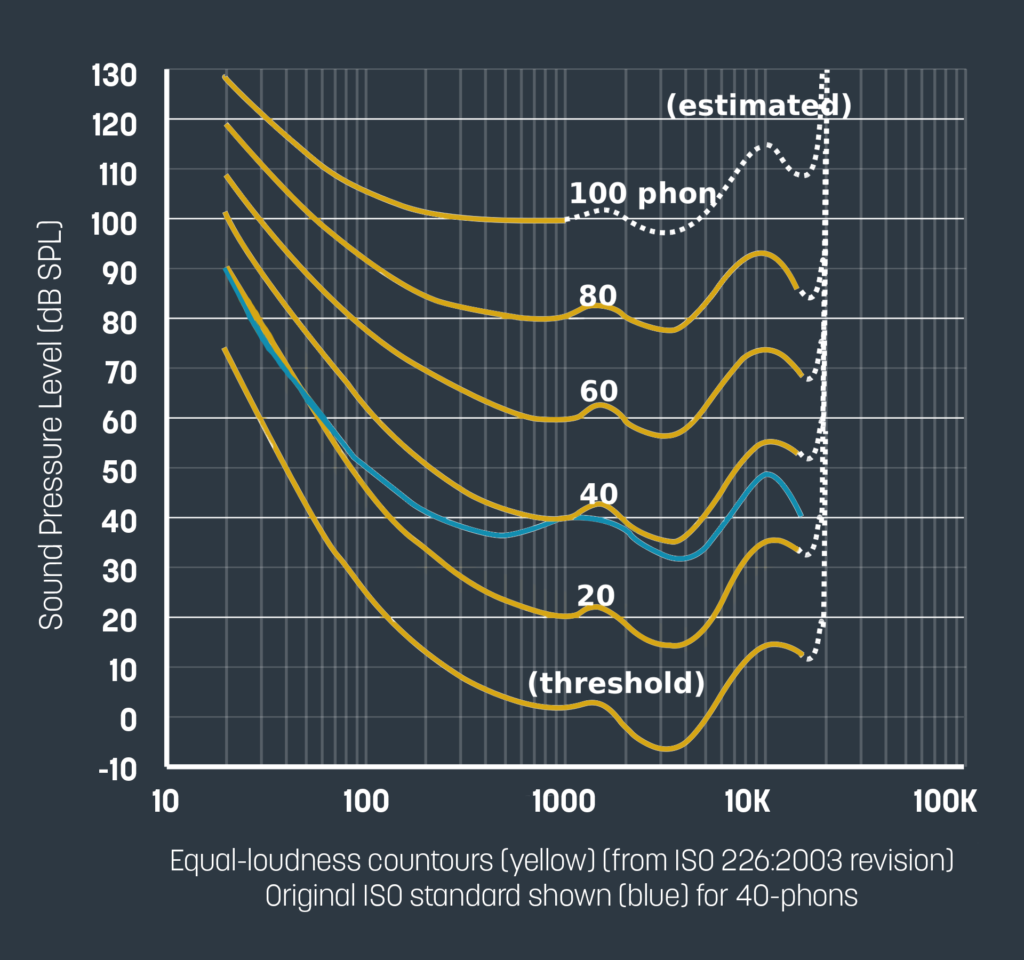
4. Equal Loudness Contours
Human hearing is not equally sensitive across all frequencies. The Equal-loudness contour illustrates how we perceive mid range frequencies as louder compared to very low or very high frequencies at the same physical level.
This has direct implications for mixing. Vocals, which sit in the mid range, tend to cut through even at lower levels, while bass frequencies require more energy to feel equally present. It also explains why mixes sound different at varying playback volumes. For musicians, this reinforces the idea that perceived loudness is not purely about level. Frequency balance plays a crucial role in how prominent something feels.
5. Tempo Perception
Tempo is often reduced to BPM, but perceived speed is influenced by much more than that. Rhythmic density plays a significant role. A track with dense subdivisions and frequent rhythmic events will feel faster than a sparse arrangement at the same BPM.
This explains why some tracks feel rushed or overly energetic despite having a moderate tempo, while others feel relaxed even at higher BPMs. When something feels off in terms of pacing, the issue is often not the tempo itself but the distribution of rhythmic information. Adjusting subdivisions, removing elements, or simplifying patterns can dramatically shift how a track feels without changing its BPM.
6. Binaural Localization
Our sense of space in sound comes from how both ears work together, a process called binaural localization. The brain compares tiny differences between what each ear hears using two main cues: interaural time difference (ITD) and interaural level difference (ILD). ITD refers to the slight difference in the time it takes for a sound to reach each ear, while ILD refers to the difference in loudness between the ears. These small variations help the brain figure out where a sound is coming from.
In music, this is what makes stereo imaging feel real and believable. When you pan a sound, you are essentially manipulating these cues to position it in space. So instead of thinking of panning as just left or right, it helps to think of it as placing sounds within a three dimensional field. Using ITD and ILD intentionally can make your mix feel wider, clearer, and more natural, rather than just spread out.
7. Precedence Effect (Haas Effect)
The Precedence effect, commonly called the Haas effect, explains how your brain deals with very short delays between similar sounds. If the same sound reaches your ears twice with a tiny delay (usually under about 40 milliseconds), you don’t hear two separate sounds. Instead, your brain merges them into one and uses the first sound to decide where it’s coming from.
In music production, this is used to create width. For example, if you duplicate a sound and delay one side slightly, it can feel wider without sounding like an echo. The key is keeping the delay short enough that it blends. Done well, it makes a track feel bigger and more spacious without adding clutter.
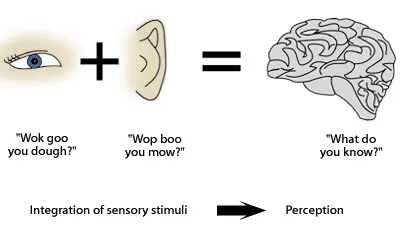
8. McGurk Effect
Sound perception does not operate in isolation from other senses. The McGurk effect demonstrates how visual information can alter what we hear. When auditory and visual cues conflict, the brain integrates them into a new perception.
In music, this is particularly relevant in live performance and visual media. The presence of a performer, their gestures, and the overall visual context can influence how the sound is perceived. It highlights the fact that listening is often a multisensory experience, especially in contemporary formats where audio and visuals are closely linked.
9. Timbre Perception
Timbre refers to the quality or character of a sound that distinguishes it from others, even when pitch and loudness are the same. It is shaped by the spectral envelope, harmonic content, and temporal characteristics such as attack and decay.
This is why different instruments playing the same note sound distinct, and why we describe sounds using terms like warm, bright, or harsh. Timbre carries a significant portion of the emotional content in music. For musicians, it is often the primary way to shape identity and mood within a track. Sound selection and processing decisions are, at their core, decisions about timbre.
10. Expectation and Predictive Processing
The brain is constantly engaged in predictive processing. It uses past experience to anticipate what will happen next. Music interacts directly with this system by either fulfilling or violating those expectations.
When a progression resolves as expected, it creates a sense of closure. When it deviates in a controlled way, it creates surprise and interest. This dynamic between expectation and deviation is central to musical expression. As a musician, you are effectively guiding the listener’s expectations and deciding when to align with them and when to challenge them.

Your ears aren’t really lying to you, they’re just interpreting. What you hear is shaped by context, memory, and the way your brain makes sense of sound. That doesn’t make your ears unreliable, but it does mean they’re not objective. As a musician, the goal isn’t to distrust your hearing, but to understand it. Because once you know how perception works, you stop guessing and start making choices that truly translate.