




















Have you ever heard a song that felt blue?
Or a chord that somehow felt warm, like orange light?

Most of us say things like this casually. It sounds poetic, maybe even a little dramatic. But for some people, it’s not a figure of speech at all. It’s literally how they experience music. This comes from something called Synesthesia. In the simplest sense, it’s when the brain mixes up the senses a little. Instead of hearing, seeing, and feeling as completely separate things, they overlap. So a sound might automatically trigger a colour, or a word might have a taste, or a number might feel like a texture.
One specific kind of this is called chromesthesia, which is when people see colours when they hear sounds. And the wild part is, they’re not trying to imagine it. It just happens. Effortlessly. A certain note might always feel like deep blue. A specific voice might always show up as a muted green. It’s consistent, almost like their brain has its own built-in colour palette for sound.

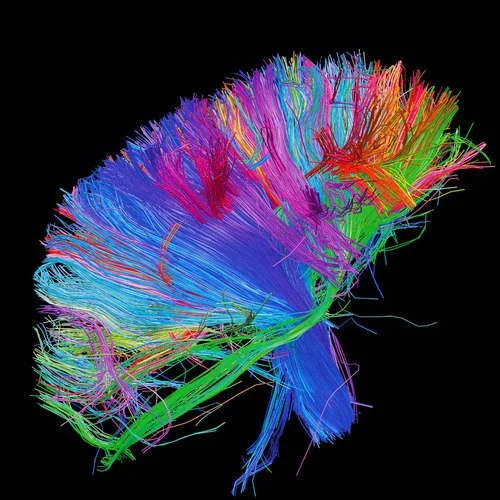
What’s going on inside the brain is actually pretty beautiful. Biologically speaking, the theory of cross-activation explains chromesthesia. In the average brain, there is a clear distinction between the processing centers of sound and those for vision. Communication occurs only when necessary. In individuals with synesthesia, however, these distinctions become more fluid. For example, the sound-processing centers, such as the auditory cortex, activate the nearby centers that process visual information. Thus, rather than an individual experience of hearing, a person hears while seeing the colours associated with those sounds. There is no superimposing one sensation over another because this is a simultaneous occurrence of two distinct sensory experiences.
This phenomenon can be extended to a secondary aspect, involving associative learning and memories. The human brain establishes connections through repetition, associations, and emotions. This is why, for example, people often associate certain smells with different periods of their lives. In a similar manner, the human mind learns patterns through repetitive exposure to specific sounds and colours. Synesthesia makes these connections more reliable, which is why a particular sound will always cause a person to experience a consistent color. Some researchers believe that everyone is born with more cross-sensory connections, and most of them get pruned away as we grow. In synesthesia, some of these connections remain.

And this isn’t just some rare, abstract thing with no real-world connection. Some well-known artists have talked about experiencing music this way. Pharrell Williams has said that he sees chords as colours and uses that to guide what he creates. Billie Eilish often describes her songs as living in very specific visual worlds. For them, music isn’t just something that sounds right. It has to look right in their mind too. Kanye West has also spoken about how sound feels visual and textured to him, saying:
“I see sounds… everything I make is a painting.”
But here’s where it gets interesting for the rest of us.
Even if you don’t have synesthesia, you’re not completely outside of this way of experiencing music. You’re already doing a softer version of it all the time.
Think about how you describe sound. You say things like “this feels warm” or “that sounds bright” or “this mix is muddy.” None of those are technically sound terms. You are borrowing from touch and sight to explain what you’re hearing. That’s your brain naturally connecting different senses, just not as intensely.
And then there’s emotion. Some songs feel like faded photographs. Some feel sharp and neon. Some feel heavy, like they sit in your chest. You may not literally see colours, but you feel them in a way that’s not just about sound. This is actually something you can use, especially if you make music. When you stop thinking of music as just frequencies and start thinking of it as feeling, space, and even color, your decisions become way more intuitive. Instead of getting stuck in “is this technically correct,” you start asking better questions.
Does this sound feel too dark?
Is this section too crowded?
Do the highs feel harsh, like bright light hitting your eyes, or soft, like a glow?
You start shaping your track the way a painter builds a canvas. You balance things. You create contrast. You leave space where it’s needed. Reverb starts feeling less like an effect and more like distance. You’re placing sounds somewhere, closer or further away. Layers stop being just layers. They become textures that either blend or clash. A lot of musicians already think like this without even realizing it. They say they want to “clean up” a mix or “warm up” a sound. That’s not technical language. That’s sensory language. And it works.
At the end of the day, music isn’t just something you hear. It’s something your brain builds using everything it knows, from memory to emotion to imagination.
For some people, that includes actual colour. For everyone else, it still includes feeling, texture, and space in a way that goes beyond just sound.