








A lot of shauharty has been about mythos, a product of his own narratorial music-making that almost functions as a literature of himself, and his public construction by his reverent fanbase who have nurtured his work like artifacts amongst themselves. In his latest project, he sets that all on fire, jeopardizes any solid image that anyone might have had of him, and presents you with a corpus of work that repeatedly insists that it’s alive, much like its author.
On Farookh, a 47 minute long, 14 track mixtape — shauharty engages in perhaps what could be called a metaphorical grave-digging, because calling it archaeology would be attributing a science to it, and archiving renders it too blunt. For the most part, he is shoveling through time for samples, references, stories, things that help him put his own art into perspective, while also clawing through his own psyche to make sense of himself — all the while performing and setting it all out for display and consumption.
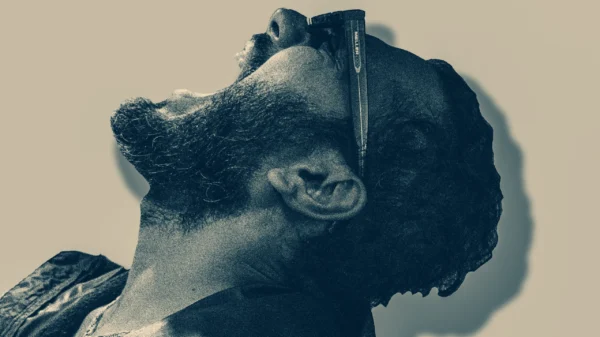
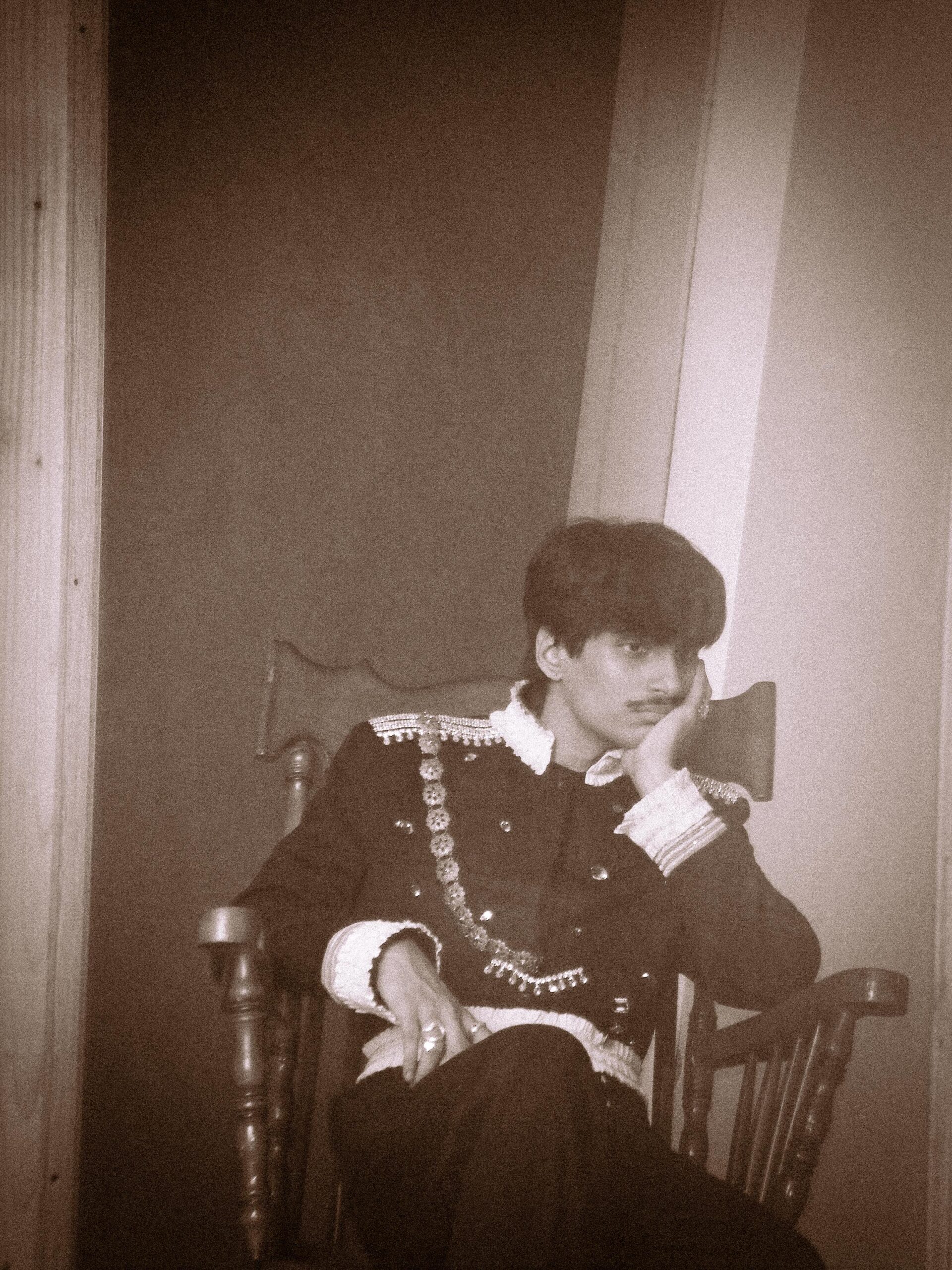
The cover art is a reference to a portrait of Farouk I of Egypt, the hedonistic, controversial ruler of Egypt and Sudan between 1936 and 1952. A press release from the artist informs me, “The cover art of the project is a reinterpretation of an archival portrait of King Farouk of Egypt. Known for his opulence and contradictions, King Farouk’s story, of indulgence, decay, and the weight of perception, mirrors the very themes Farookh wrestles with. But rather than glorifying that image, shauharty subverts it. Bathed in sepia tones, his own gaze carries not arrogance but introspection, the decadence replaced with melancholy, the excess replaced with honesty. The visual, much like the project itself, becomes a metaphor for transformation: the shedding of illusion in pursuit of truth.”

The artist reconfirms that insistence of configuring his own image, “I made this project to look at myself better. I wasn’t happy with how I was being perceived, not just by others, but by myself. Somewhere along the way, I lost touch with who I was and where I came from. Farookh is me trying to reconnect with that, with home, with the boy who grew up in the Northeast, and the man trying to make sense of it in a big city like Delhi.” When I take a look at the titles of the tracks, and the intuitive, smart collaborations that are splayed across its body, I assume that the self that the artist is projecting must be a curated one, moderated and sharply incisive. I am obviously proven wrong, on first listen — because the project is almost a sonic negotiation of sorts — where the artist battles out with prior preconceived notions that he has encountered and built for himself, reaching for something more tangible within himself. There is ego and there is its consequent destabilization, there is the artist and the person, and there is music and the impact of making it accessible — and the active grappling is what comes through, resolutely.
The mixtape begins with a near-carnivalesque opening, with pakeezah, the artist’s frequent collaborator and producer voicing a welcome before reining the artist in on the titular Farookh. You get the sense quite early on, is that shauharty has written the project — which is to say that it is replete with lyrics that are not filler for soundscapes, that he treats words with the same importance he does his samples and his percussions and his synths. As he circles around the name Farookh, he plays into the constructions of him — a reference to Freddie Bulsara (Mercury, born Farrokh Bulsara) is delightful and one can derive that the historical underpinnings of this persona that he is building weighs heavy, as he insists that he is very unlike your favorite rapper — resistant to having notes and posing about “having chicks”.The sonics of this mixtape shift from Nas, DOOM, takes a lot from jazz and R&B — finds itself in alternative hip-hop renditions from the 90s, plays with texture in spatiality and sampling. It snowballs into the asynchronous, irreverent Saddam Hussaine, which also has a short film accompanying it — 70s Bollywood and western in influence, as a Sonar Kella derivative, impossible, indignant wild goose chase that is born out of recall and the reincarnate, almost. Pahaad’s voice adds to a kind of mystique and sinister — and one has to appreciate the cinema of the arrangement, because clearly — there is a definitive visual invoked on this one, and the sound is structured to ensure that envisioning translates.
The mixtape has got incredible features all across — some of the best ones being ARUN YDV on Jholi Bharde Meri (which also features samples from a Qamar Ejaz shayeri as the intro and the outro), GHILDAYAL, Frappe Ash, and Raaj Babu on Keith Haring, and Ahmer on Stancyk!. Karshni’s soft, almost ghostly vocals churn the more fragile core of the mixtape, especially on the outro to Earth, Wind and Fire.What is admirable, and also rare — is that shauharty’s collaborators match his streak for the dramatics with their respective storytellings, but they do not weaken the basis for the mixtape — and this extends to the multiple producers (30KEY! does some incredible work on Delicate Ache of the Unknown) on the record, who tether their signatures to the central ethos, diversifying, but not deviating.
The mixtape also finds itself in a practice of hyper-referentiality, which is done through verbal callbacks and callouts, and many, many samples (there is an interlude of Osho proselytizing on love as meditation set to a seductive instrumental, true to its name Pitstop 4 Sex and a Casablanca dialogue chop on Indulgence of Adolescence) — which also clarifies that shauharty, as an artist, does have the political idiolect to be vocal in his indignance, but is smart enough about it to make meanderings. One such sample is Barsha Rani Bishaya’s 2020 speech against the CAA in Assam, on Taint Lassos, one of my personal favorites on the record. Over the course of 14 songs, shauharty almost calms down — goes through a bildungsroman, comes of age, as Farookh, as the other, as an artist, as a person — by the time he reaches Earth, Wind & Fire — he is ready to talk about his grief, look himself in the eye and turn away from refractive mirrors. House On The Hill is a good concluding track — the smooth jazzwork is reminiscent of his older work on MADHEERA. Green Park’s Arpan Kumar makes an appearance, and his gentle crooning draws the curtain on it all.
Lauren Berlant, in Cruel Optimism, writes, “Desire describes a state of attachment to something or someone, and the cloud of possibility that is generated by the gap between an object’s specificity and the needs and promises projected onto it. This gap produces a number of further convolutions. Desire visits you as an impact from the outside, and yet, inducing an encounter with your affects, makes you feel as though it comes from within you; this means that your objects are not objective, but things and scenes that you have converted into propping up your world, and so what seems objective and autonomous in them is partly what your desire has created and therefore is a mirage, a shaky anchor”, — the friction between shauharty, and consequently Farookh’s selves and their interpretations by his audience and perceivers all are located on this fulcrum of desire, perhaps. Ironically, in this conscientious, self-aware tightrope act that breaks the back of many camels of ache — one shall be completely remiss, if they were to look away.